

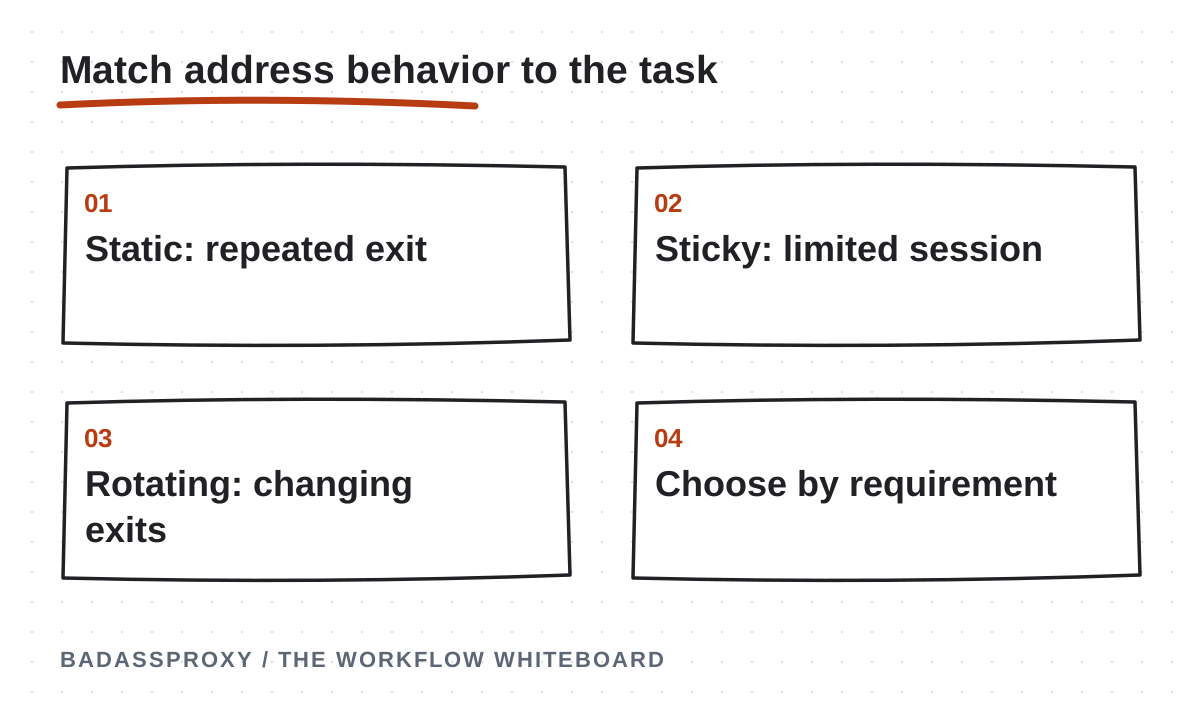
Static and rotating proxies are designed around different address behavior. A static service aims to preserve an assigned exit for repeated use. A rotating service changes exits according to its configuration. Neither label tells you everything about quality, permissions, or security.
For one long-term social account, constant address changes usually do not solve an ownership or recovery problem. A persistent route can be easier to document and troubleshoot. That is an operational judgment, not a published rule that every IP change causes a restriction.
Choose the behavior the task requires. Do not buy rotation because it sounds more private, or buy static because someone promises immunity from enforcement. First understand assignment, duration, exclusivity, and what happens when the connection fails.
What static actually promises
A static service keeps a designated exit available under the provider's assignment terms. You can generally reconnect to that endpoint across sessions while the assignment remains active. Confirm the specific terms, because static should never be read as ownership of an address forever.
The service can still expire, experience an outage, or require replacement. Renewal may preserve the assignment, but you should verify that rather than assume it. A long-running account workflow needs a plan for the day the endpoint is unavailable.
Static is also separate from dedicated. A service may retain the same exit while sharing it between customers. If exclusivity matters, ask directly. Our static IP for Instagram guide explains how those properties affect a repeatable browser configuration.
What rotation actually changes
A rotating proxy can change exits per request, after a time interval, or when a session ends. The exact behavior depends on the service and configuration. You should know which event triggers a change before using the product for any workflow that depends on continuity.
The addresses may remain within a region or vary across locations, depending on the plan. They may also come from different networks. Rotation is therefore not one universal behavior; it is a family of assignment policies that need specific documentation.
For legitimate testing or permitted data collection, varying network conditions may be part of a defined task. Those uses still require authorization and compliance with applicable terms. Rotation is not a general permission to ignore access controls or distribute prohibited activity across addresses.
Sticky sessions are a third case
A sticky session attempts to keep one exit for a limited session period. It can feel static during a short test while still changing later. The address may also become unavailable if the underlying resource disappears or the provider reassigns it.
Ask how long the session lasts, whether idle time matters, and what happens after a reconnect. Confirm whether the provider guarantees the assignment or only attempts to retain it. “Up to” a duration is different from a commitment to preserve the same exit throughout a service term.
For a long-term social workspace, compare the requirement with the actual product. If you need weeks of continuing assignment, a short sticky interval may not satisfy it. Avoid discovering that distinction after configuring a business-critical profile around an assumption.
Why continuity suits a persistent account
A continuing account workflow benefits operationally from fewer unnecessary changes. If the browser profile, connection configuration, and authorized operators are documented, a problem is easier to investigate. You can compare today's behavior with a known baseline instead of reconstructing a constantly changing route.
For a traveler, the underlying Wi-Fi can change while a configured static exit remains the same. That does not prevent connectivity loss, preserve deleted cookies, or prove who controls the account. It simply holds one selected network variable steady.
The Vietnam account-stability guide presents that model in a relocation scenario. Its reasoning is about clarity and consistency, not a claim that Instagram has published a safe IP pattern or endorsed a particular proxy product.
Why unnecessary rotation complicates diagnosis
Imagine a session that moves through several exits while a page fails intermittently. The operator now has to consider different endpoints, routes, locations, and service states alongside the browser and account. That does not prove rotation caused the failure, but it increases the variables to inspect.
A rotating service may also make location records less straightforward to interpret. A person who does not understand the configuration could mistake expected endpoint changes for unknown access, or dismiss a real unknown session because the records always look variable.
Document expected behavior before using any changing route. If the task has no requirement for rotation, removing it can simplify operations. Do not advertise that simplification as a guarantee of fewer platform checks; the platform's decision process is not under the proxy provider's control.
Compare the options against the requirement
| Requirement | Static assignment | Rotating or sticky service |
|---|---|---|
| Repeat one exit over a service term | Designed for continuing assignment | Verify limits; may not fit |
| Change exits as part of testing | Requires planned endpoint changes | Often supports configured variation |
| Explain a browser route to a team | One documented assignment | Requires rotation rules and logs |
| Recover account ownership | Does not establish ownership | Does not establish ownership |
| Guarantee no enforcement | Cannot provide this | Cannot provide this |
The comparison is deliberately about behavior. A high-quality rotating service can be excellent for a task that needs variation and still be unnecessary for a persistent account. A static service can fit continuity while failing other requirements such as compatibility or support.
Pair the route with the browser deliberately
A persistent AdsPower profile retains its browser workspace while the configured proxy handles its network route. Those components can support a repeatable setup when the account owner needs managed profile organization. An ordinary browser profile may meet simpler requirements without additional software.
Read the profile and static proxy setup guide before configuring important access. Test the connection without making account changes, protect credentials, and verify that the observed exit matches the intended assignment. Recheck after planned configuration changes.
Do not assume the proxy covers every application. A native phone app, another browser, or a desktop tool may connect separately. If you need device-wide routing, review the VPN comparison and describe the required coverage before selecting a product.
Network category remains a separate question
Static and rotating describe assignment behavior. Residential, ISP, mobile, and datacenter describe other aspects of the service. A product can combine those properties in different ways, so the plan needs more than a single attractive label.
Ask about infrastructure, sourcing, shared versus dedicated use, supported protocols, and location availability. A residential pool may rotate, while a datacenter address may remain assigned. Neither combination can guarantee that a platform accepts a particular account or action.
Use the residential versus datacenter guide to evaluate those dimensions. Compare documented service behavior and provider transparency rather than assuming that one label automatically means a cleaner history, stronger security, or better long-term support.
Prepare for an unavoidable address change
Even a static setup may eventually need replacement. A provider can retire infrastructure, an assignment can expire, or your operating requirement can change. Treat that event as a planned configuration change wherever possible, not evidence that the whole account strategy failed.
Record the reason, verify the replacement route, and update the intended workspace once. Keep recovery methods available and allow time to handle legitimate platform prompts. Avoid combining the network replacement with unrelated changes to recovery details, devices, and browser storage unless security requires it.
For teams, tell authorized operators when the change occurs and who can troubleshoot it. Update renewal and support records. The purpose is to preserve an understandable process through necessary change, not to freeze every technical detail indefinitely.
Here is a way to test a provider's description. Record the external address at the start of a non-sensitive session, reconnect using the documented method, and check again after the advertised interval. Compare those observations with the assignment policy. Keep the test focused on your service rather than experimenting against platform safeguards. A mismatch should become a support question before the connection becomes essential to daily work.
Also ask what happens when a sticky endpoint disappears. Some services select another address automatically, while others can fail the request. The distinction matters for both continuity and availability. Confirm the behavior in current documentation and make sure every authorized operator knows which outcome to expect during interruption before relying on the configured workflow for important business tasks.
Choose a service you can operate
Define the workflow in one sentence before purchasing. For example: one authorized browser workspace needs a continuing assigned exit while its owner travels. Then verify that the product's duration, compatibility, availability, and support meet that requirement.
Keep strong passwords, two-factor authentication, recovery access, and native platform permissions in place. A stable connection cannot compensate for shared credentials or unauthorized activity. If an account is restricted, use official review or recovery rather than treating endpoint rotation as a remedy.
For continuing browser workflows, explore BadAssProxy static options. Choose rotation only when the technical task actually requires changing exits. The most useful connection is the one whose behavior matches the job and whose limits the account owner understands.