

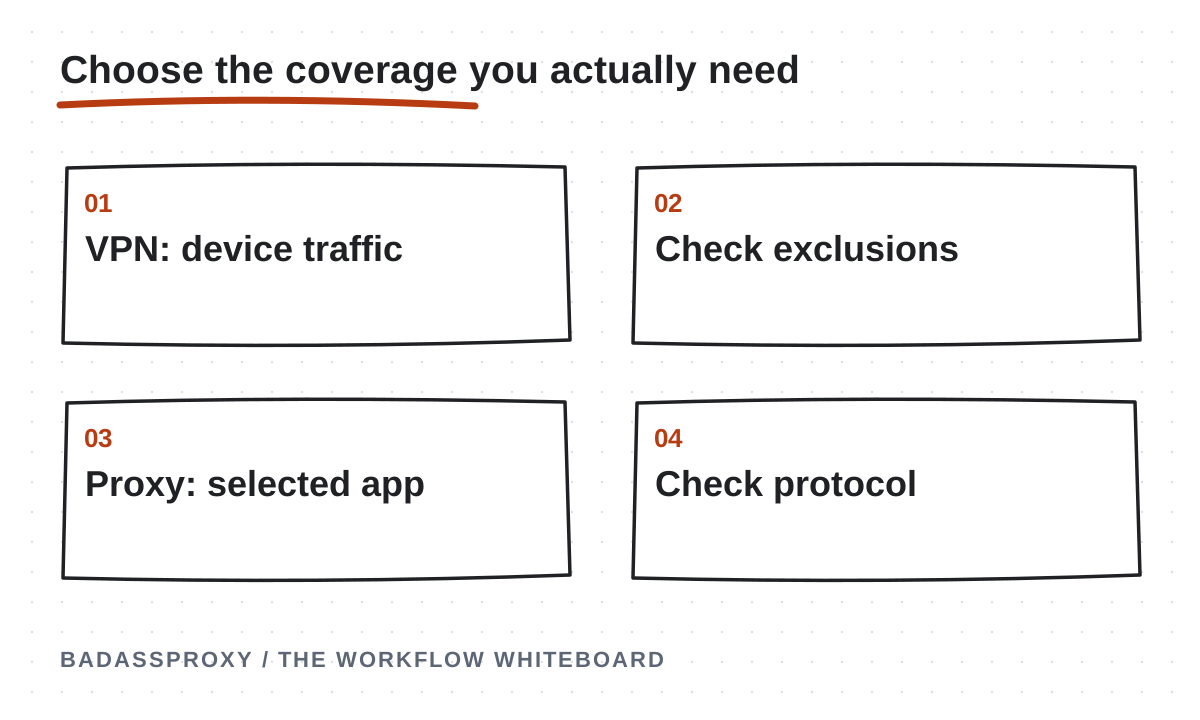
Choosing between a VPN and a static proxy for Instagram starts with the traffic you need to route. Do you want a connection tool for your whole laptop, or a consistent exit for one authorized browser profile? Those are different requirements, even though both products can route traffic through another server.
The second question is address assignment. A VPN can offer a dedicated IP, while a proxy can use a changing shared pool. The product category alone does not tell you whether tomorrow's login uses the same exit as today's.
Compare coverage, encryption, assignment, maintenance, and failure behavior together. Neither product is an account-protection guarantee, and neither replaces strong recovery methods or the platform's official response to a security notice.
What a VPN usually covers
A typical consumer VPN creates an encrypted tunnel between your device and the provider's endpoint. Depending on the operating system and configuration, much of the device's internet traffic can travel through that tunnel. Split tunneling and other exclusions can change the coverage.
This is useful when you want a single connection policy for several applications. A browser, messaging app, and other supported traffic may use the same VPN route without separate proxy settings in each application. You still need to understand which traffic is excluded.
The VPN provider becomes another party in your network path. Evaluate its security practices, software maintenance, and support instead of assuming that encryption makes every service equally trustworthy. A VPN cannot make a phishing page genuine or prevent you from willingly entering credentials into one.
What a static proxy usually covers
A static proxy can be configured for one browser profile or a compatible application. That traffic uses the designated exit while unrelated applications may use their normal routes. This narrower scope can be useful for a managed social-media workspace.
For example, an AdsPower profile can have its own proxy configuration. A video editor running elsewhere on the computer need not share that route. The separation can keep network costs and troubleshooting focused on the application that actually requires a persistent exit.
Coverage depends on the application and protocol. Do not assume a browser proxy protects the whole device or handles every browser networking feature identically. Read the relevant documentation, verify the observed connection, and keep the scope written down for anyone who operates the workspace.
Encryption needs a precise explanation
HTTPS protects the connection between a browser and a genuine website when certificate validation succeeds. A VPN adds an encrypted segment between the device and the VPN endpoint. These are different layers, and modern HTTPS remains important with or without a VPN.
A proxy's connection to your device may or may not be encrypted, depending on its protocol and configuration. SOCKS5 by itself does not provide encryption. An HTTP proxy used to reach an HTTPS website is not the same thing as an HTTPS connection to the proxy server.
Ask the provider to explain the actual protocol rather than accepting “secure proxy” as a complete description. Never disable certificate validation to make a service work. Our public Wi-Fi guide distinguishes encrypted web traffic from broader device and network concerns.
Compare the plan, not the label
| Requirement | Typical VPN consideration | Static proxy consideration |
|---|---|---|
| Traffic coverage | Often multiple device applications | Often one configured application |
| Stable address | Dedicated IP may be an add-on | Confirm assignment and renewal |
| Shared infrastructure | Many plans share exits | Static can still be shared |
| Encryption | Tunnel usually encrypts device-to-server traffic | Depends on protocol and application |
| Administration | Device client and routing settings | Profile settings and provider credentials |
This table describes common patterns, not every provider. Some VPNs support application-specific routing, and some proxy systems provide broader gateways. Read the plan details and test the features you actually need instead of treating a category comparison as a technical guarantee.
Address consistency is a separate decision
A traveler who repeatedly chooses VPN endpoints in different countries deliberately changes the apparent network route. A static proxy can keep one route stable, but so can an appropriately configured dedicated-IP VPN. Stability is a service property, not something unique to the word “proxy.”
Likewise, a rotating proxy is a poor match when your requirement is an unchanged exit. A sticky session may only last for a limited period. Ask what survives a reconnect, a browser restart, a renewal, and an underlying network change.
Our static IP guide explains those purchasing questions. No provider can promise that a stable address prevents a login challenge. The measurable benefit is a repeatable connection you can document, not a claim about Instagram's unpublished decision process.
Choose a VPN for a device-level requirement
A VPN may be a practical fit if you need one supported tool to handle several applications while traveling. Verify that your operating system is supported, the provider explains exclusions, and the connection behaves predictably when Wi-Fi drops or the device wakes from sleep.
If address continuity also matters, check whether the plan includes a dedicated or otherwise stable exit. Read the terms carefully: an advertised dedicated address can still require selecting a particular server or configuration rather than pressing the application's default connection button.
Your privacy objective should be explicit. A VPN can change what a local network observes, but it does not eliminate trust; it shifts part of that trust to the provider. Account security still depends on authentic websites, protected devices, and appropriate authorization.
Choose a static proxy for a profile-level requirement
A static proxy may fit when one persistent browser workspace needs a managed exit and other applications should remain independent. This is especially understandable when a team already organizes client work into clearly named, authorized profiles.
Keep the configuration limited to a documented purpose. Record which profile uses which service, who owns renewal responsibility, and where credentials are stored. Avoid placing usernames and passwords in ordinary project notes merely because the proxy feels less important than the social account itself.
Use our browser and static proxy setup guide for a practical sequence. If your existing personal account works well through your normal browser and connection, adding a specialized proxy may introduce maintenance without providing a benefit you actually need.
Combining them requires a routing plan
It is possible for a browser proxy connection to travel through a device VPN. That arrangement introduces two providers and additional routing behavior. It may meet a specific requirement, but “more tools” is not automatically a better security design.
Before combining services, draw the path from application to destination. Identify which exit the website should see, which component handles name resolution, and what happens when either service fails. Check the providers' compatibility guidance rather than assuming that every combination works correctly.
Test with non-sensitive browsing before relying on the setup. Verify the expected exit after reconnecting and changing underlying networks. If you cannot explain why both products are necessary, simplify the design. A connection that nobody understands is difficult to support during a travel emergency.
Use a small acceptance checklist
Confirm that the service works on your actual travel device and normal applications. Check the assigned exit, connection stability, latency, and upload behavior. Open a support request about a non-sensitive configuration question to learn whether the provider gives clear, specific answers.
Then test ordinary interruptions: closing the browser, restarting the connection, and switching between your trusted Wi-Fi and hotspot. Record what changes. If a service silently returns traffic to a direct connection after failure, decide whether that behavior fits your operational requirement.
These are service tests, not attempts to reverse-engineer Instagram. Do not measure success by whether a newly configured account avoids prompts for an afternoon. A short observation cannot establish that a tool changed the platform's security assessment or prevented enforcement.
Consider two very different travelers. One uses email, messaging, and several browsers on an unfamiliar network and wants consistent device coverage. Another already has a secure device routine but needs a particular client workspace to use an assigned exit. Their requirements, travel patterns, and responsibilities can lead to different choices without either product being universally better. Write the requirement before comparing subscription prices, and include the recovery path if the chosen service stops working. A clear fallback might be contacting the provider, postponing sensitive administration, or using a documented alternative connection. It should never depend on pretending a policy restriction disappeared when the network changed.
Keep the account-security work separate
Whichever route you choose, protect the account's email, enable two-factor authentication, and maintain recovery methods that survive a SIM change. Use available business roles for teammates. A common exit address does not make anonymous shared access appropriate.
If a policy notice or unexpected login appears, use the official support and security controls. Our Vietnam account-stability guide puts routing in that broader context, while the static versus rotating comparison examines assignment behavior in detail.
For a profile that needs a continuing assigned exit, compare BadAssProxy static residential options. Choose the plan around coverage, documented requirements, and verified behavior. A good connection choice makes the workflow understandable; it does not promise immunity from the platform's rules.