

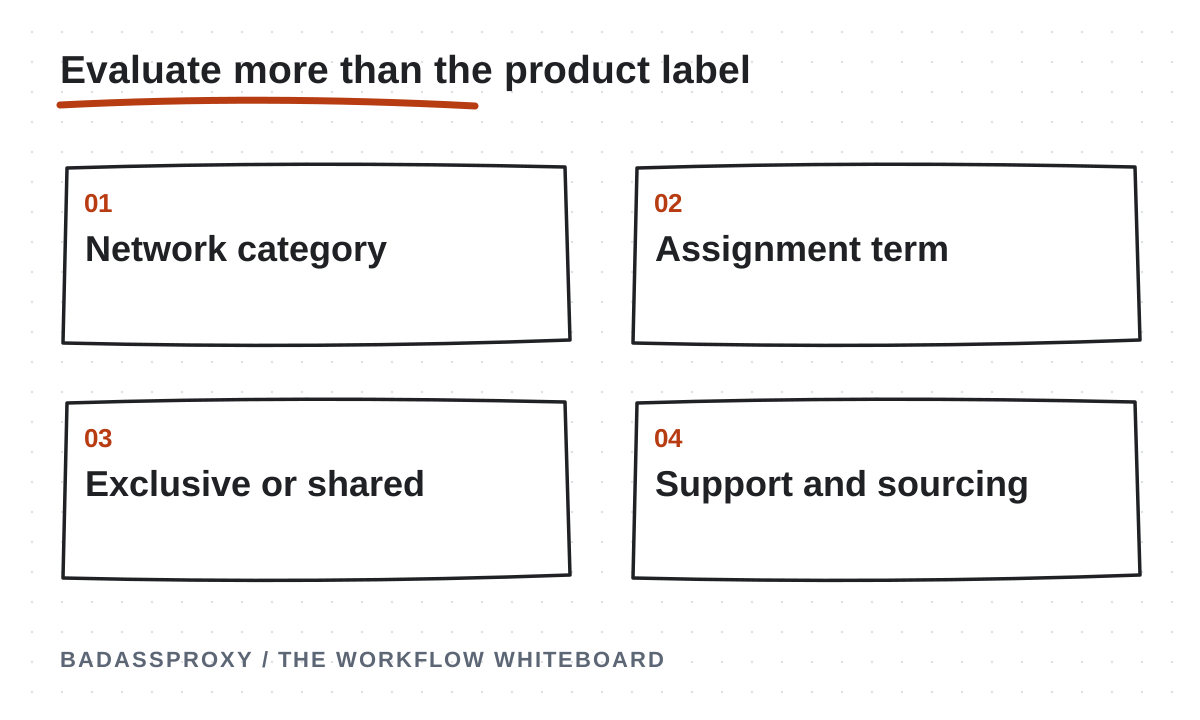
Residential static proxies and datacenter proxies describe different network offerings, but neither label is a complete buying decision. For a legitimate social-media workflow, you also need to know whether the exit stays assigned, whether it is shared, how the service is maintained, and what the provider actually supports.
The common sales shortcut is to call residential addresses trustworthy and datacenter addresses suspicious. Reality is more complicated. A category does not reveal every address's history, the quality of the provider, or the platform's decision about a particular account.
Evaluate the service as infrastructure. Ask concrete questions, test a small authorized workflow, and compare the costs of operation as well as the advertised price. Avoid promises that any network type guarantees acceptance or prevents account enforcement.
Understand the terminology before comparing prices
A residential offering generally refers to addresses associated with consumer internet connectivity. A datacenter offering generally uses hosting infrastructure. An ISP proxy or “static residential” product may use ISP-associated addresses hosted on servers, rather than traffic passing through a person's household device.
Providers use these labels differently, so request a description of the architecture. Ask what network registration indicates, where the connection is hosted, and how addresses are assigned. Do not assume that a residential label proves there is a dedicated home connection behind every endpoint.
Likewise, datacenter does not mean inherently abusive. Businesses use hosted infrastructure for many ordinary services. Its relevance to your purchase is how it matches the operational requirement and the destination's permitted use, not a simplistic claim about whether the address looks like a person.
Separate network type from assignment behavior
A residential pool can rotate addresses rapidly, while a datacenter product can keep the same exit assigned for months under a continuing service. Network category and address persistence are separate dimensions. You need to inspect both rather than assuming one implies the other.
Static does not necessarily mean exclusive. Other customers may share an address that remains unchanged. Dedicated does not necessarily mean permanent. The provider can still have renewal conditions, maintenance events, and replacement procedures that affect the assignment.
Our static IP guide for Instagram explains those terms in context. For a persistent social account, start by writing the required behavior: an assigned route for a specified period, with clear support and renewal arrangements. Then compare products against it.
Residential sourcing needs clear answers
When a network uses third-party devices or bandwidth, ask how participants consent, what they understand, and how they can stop participating. Request information about abuse handling and controls on customer use. A vague residential label is not a substitute for transparent sourcing.
For server-hosted ISP offerings, ask the provider to explain that distinction instead of presenting the product as a private household connection. Honest architecture descriptions help you understand availability, routing, and who controls the infrastructure you depend on.
Do not infer lawful sourcing from a high price or a polished website. Review the available terms and ask questions before purchase. If answers are unclear, uncertainty itself is relevant to your decision, particularly when the connection will support important business accounts.
Datacenter products can have practical advantages
Hosted proxy services may offer predictable capacity, straightforward provisioning, and competitive prices. Their performance depends on the specific provider, location, and workload, so test rather than treating those typical advantages as a guarantee for every plan.
A hosted route can also be easier to describe operationally: a defined endpoint, assigned credentials, and a service term. That simplicity can matter when a small team must support its own configuration across travel and staff changes.
The tradeoff is that online services may identify hosting infrastructure as such. That does not establish how Instagram will treat your account, and it should not lead to claims that another category is undetectable. Use accurate descriptions and follow the destination platform's rules.
Compare the properties that affect your work
| Property | Residential or ISP offering | Datacenter offering |
|---|---|---|
| Architecture | Consumer or ISP-associated; clarify hosting | Typically hosted server infrastructure |
| Assignment | Can be rotating, sticky, or static | Can be shared or dedicated and static |
| Performance | Depends on actual infrastructure | Depends on capacity and location |
| Sourcing questions | Consent or address-capacity arrangements | Provider and network ownership |
| Platform acceptance | Never guaranteed by category | Never guaranteed by category |
Use this comparison to structure questions, not to declare a universal winner. The best product is the one whose documented behavior fits your authorized workflow and whose limitations you understand before committing.
Ask about exclusivity and address history
Find out whether your exit is shared with other customers, whether the provider restricts abusive activity, and what support does when a destination rejects connections. Do not expect a provider to certify an address as acceptable to every website indefinitely.
An address's past use may be difficult for a buyer to establish. Third-party reputation checks can offer clues, but they do not disclose a platform's internal assessment. Avoid treating a single public score as proof that an account will never receive a challenge.
If the provider offers replacement, ask when that policy applies and what changes operationally. Constantly requesting replacements is not a sound recovery strategy. It can interrupt continuity and conceal a problem that actually concerns credentials, account behavior, or browser state.
Test actual performance and compatibility
Evaluate the activities your team performs: opening the account, loading ordinary pages, uploading authorized content, and handling normal session interruptions. Check latency from the places you actually work. An endpoint that is fast in one country may feel different after a long relocation.
Confirm supported protocols, address families, authentication methods, and application compatibility. A browser needs settings that match the service. Buying an IPv6 product does not automatically make every application or destination compatible with your chosen route.
Use non-destructive checks first and document the result. A connection test shows that a route works; it does not test future enforcement outcomes. If your requirements include broader device coverage, read the VPN versus proxy guide before selecting a browser-specific product.
Calculate the continuing cost
Look beyond the first advertised price. Review term length, renewal cost, bandwidth limits, connection limits, and the effort required to administer the service. A slightly cheaper plan can become expensive if every outage consumes an hour of staff time.
Ask whether the same assignment survives renewal and what happens after expiry. Identify who receives service notices and who is responsible for payment. A continuing workflow needs a continuing operating process, not just a successful checkout.
BadAssProxy's static residential options and datacenter options provide current service starting points. Check live details before ordering rather than treating this article as a quote or a promise that every country and term is always available.
Match the connection to the browser workflow
A persistent profile and a persistent exit solve complementary problems. AdsPower can organize a browser workspace and its proxy configuration, while the provider handles network routing. Neither determines who is authorized to operate the social account.
Keep the profile secure and maintain recovery access. Use native business roles where available, protect session backups, and remove former operators from both platform and workspace permissions. A well-selected network product cannot compensate for a password circulating through uncontrolled chats.
The Vietnam stability guide shows how these layers fit together during relocation. Its recommendation is about reducing unnecessary operational changes, not making a claim that a residential or datacenter address changes Meta's enforcement standards.
A useful buying exercise is to compare two written offers using the same requirements. Ask both providers for the assignment duration, exclusivity, supported protocol, replacement policy, and support availability. Then add the total price for the same service period and expected traffic. This prevents a low introductory price from hiding a materially different product. Keep unanswered questions visible rather than filling them with assumptions about pricing, privacy, performance, or acceptance.
For technical background, MaxMind's proxy and anonymizer documentation describes distinctions its own network intelligence makes. That is evidence that address categories can be identifiable, not proof that Instagram uses that vendor or makes identical classifications. Treat external intelligence as context and keep your own acceptance criteria focused on observable service behavior. An account owner can verify an assigned exit and a working connection; they cannot independently certify how every platform will classify the address tomorrow or guarantee that the account will remain available under all circumstances.
Make a decision you can revisit
Write a short acceptance record: selected service, required duration, expected exit behavior, authorized operators, and support route. Note the alternatives you considered and the specific reason this plan fits. You can revisit that reason when the business or travel pattern changes.
If the task genuinely requires address changes, read the static and rotating comparison. If the requirement is a continuing account workspace, focus on assignment reliability and sensible administration rather than purchasing rotation because it sounds more sophisticated.
Residential and datacenter are useful categories, but they are the beginning of due diligence. Choose transparent sourcing, documented behavior, compatible configuration, and support you can use. No proxy category can replace legitimate ownership, careful security, or compliance with the platform's rules.